Definition
ATD products are distinct assemblies mounted on motor vehicles for coupling and towing trailers or semi-trailers.
Functions
Besides the main function of coupling and towing, the following auxiliary functions are also pursued: ensuring safety during towing, easy coupling, compliance with the interchangeability requirements of the relevant standards, and compliance with human and environmental protection requirements.
Classes of towing devices and their components
UN/ECE Regulation No. 55 (United Nations Economic Commission for Europe) – Uniform provisions concerning the approval of mechanical coupling components of combinations of vehicles (Annex.1.1.1.1) sets out a classification of mechanical coupling devices and components into 14 classes (A, B, C, D, E, F, G, H, J, K, L, S, T, W). This classification is summarised below.
| Class | Name | Example | Remarks |
|---|---|---|---|
| A | Coupling balls and towing brackets | 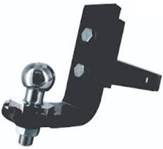 | The ball diameter is 50 mm; the towing brackets are mounted on the towing vehicle |
| B | Coupling heads fitted to the drawbar of trailers | 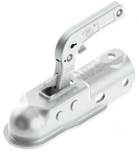 | Mounted on the trailer drawbar so that it can be connected to the coupling ball of the towing vehicle |
| C | Drawbar couplings (clevis type) | 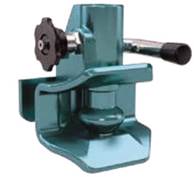 | The pin diameter is 50 mm; the device may have automatic closing and/or locking |
| D | Drawbar eyes | 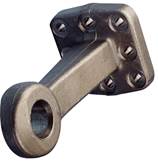 | The eye bore has a diameter of 50 mm; mounted on the trailer drawbar |
| E | Non-standard drawbars comprising overrun devices | - | Installed at the front of the towed vehicle or fixed to its chassis; designed to be coupled to the towing vehicle by means of drawbar eyes, coupling heads or similar coupling devices |
| F | Non-standard drawbeams | 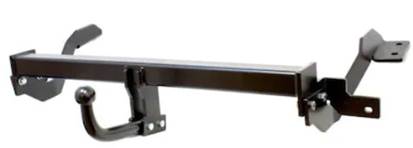 | Comprise all the components placed between the coupling device proper (e.g. the coupling ball) and the chassis structure (e.g. the rear cross member, the longitudinal members or the load-bearing parts of the towing vehicle body) |
| G | Fifth wheel couplings | 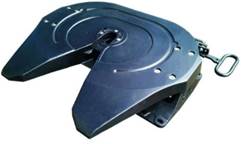 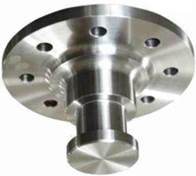 | Plate-type coupling devices with automatic locking, fixed on the towing vehicle for connection with a 50 mm coupling pin fixed on the towed vehicle |
| H | Fifth wheel coupling pins | The pin has a diameter of 50 mm, for connection with the fifth wheel coupling of the towing vehicle | |
| J | Non-standard mounting plates | Comprise all the components and devices needed to fix the fifth wheel coupling to the structure (chassis) of the towing vehicle; they may allow horizontal displacement, so that the fifth wheel coupling can slide | |
| K | Standard hook-type couplings | 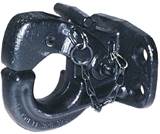 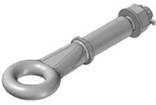 | Intended for use with toroidal drawbar eyes |
| L | Standard toroidal drawbar eyes (for class K) | Intended for use with standard hook-type couplings | |
| S | Devices and components which do not conform to any of the classes A to L, T or W | - | Used for special heavy transport, or devices used only in certain countries that comply with their national standards |
| T | Non-standard, non-automatic dedicated drawbar-type couplings | - | Usually fitted to car-transporter trailers, which can only be uncoupled with dedicated tools. They are approved as a pair |
| W | Non-standard miscellaneous automatic drawbar couplings, clevis type | - | Also include an integrated automatic connector (electric or pneumatic) between the towing vehicle and the trailer |
Specific features of towing devices for passenger cars and light commercial vehicles
– For category B passenger cars (maximum permissible total mass of 3500 kg), the trailer or semi-trailer must not exceed 750 kg; the payload the trailer can carry is approx. 600 kg.
– The characteristic performance parameters of ATDs according to UN/ECE Regulation No. 55 (Annex.1.1.1.1) are: D [kN], the horizontal force; Dc [kN], the horizontal force for a centre-axle trailer; S [kg], the mass (vertical static load) applied on the coupling ball; V [kN], the amplitude of the vertical force applied on the coupling of a centre-axle trailer.