Design data
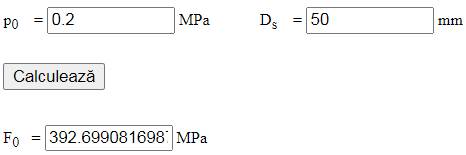
Preload pressure of the spherical pair: p0 = (0.1…0.2) pmax = (0.1…0.2)·1.3 = (0.13…0.26) MPa, with pmax = 1.3 MPa; p0 = 0.2 MPa is adopted.
Spring preload force: F0 = 392.7 N.
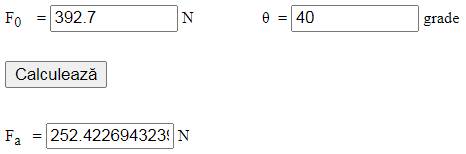
Spring assembly force: Fa = 252.5 N.
Functional constraints: threaded shank Md = M10 (metric thread of 10 mm diameter); spring stroke between the coupled and uncoupled positions h = 8 mm.
Operating constraints: temperature T = (−30…40) °C; outdoor working environment with high humidity.
Design constraints: interchangeability with the coupling systems in use in the EU.
Material and heat treatments
The helical spring is made of the special spring steel 56Si17A (0.56% C, 1.7% Si).
Material properties
| Material | Heat treatments | Ultimate tensile strength |
|---|---|---|
| 56Si17A | Annealing, quenching and tempering | σr = 1600 MPa |
Heat treatments
Annealing at (680…700) °C before forming.
Quenching at (840…860) °C with oil cooling and tempering at (580…600) °C, HRC 48…50, after forming (coiling into the helical shape).
Sizing and checking
Calculation data
– loading: Fn = 252.5 N, F1 = 40 N;
– dimensions: Dm = (1.4…1.6)Md = (1.4…1.6)·10 = (14…16) mm; Dm = 15 mm is adopted;
– materials: τa = 650 MPa, G = 8.5·104 MPa.
Sizing
Wire diameter
Required wire diameter dnec = 2.45 mm;

the wire diameter d = 2.5 mm is adopted.
Number of active coils
Required number of coils nnec = 4.63;
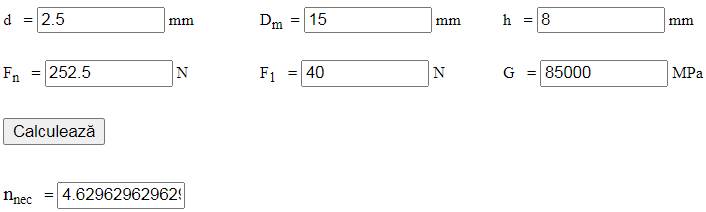
n = 5 active coils are adopted.
Other dimensional parameters
– number of end (seating) coils nr = 1.5;
– total number of coils nt = n + nr = 6.5;
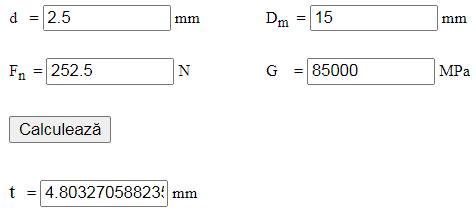
– pitch of the free (unloaded) spring t = 4.8 mm;
– free length of the spring H0 = n·t + nr d = 5·4.8 + 1.5·2.5 = 27.8 mm;
– length of the spring under the assembly force F1 = 40 N and under the nominal force Fn = 252.5 N: H1 = 26.1 mm and Hn = 17.5 mm respectively;
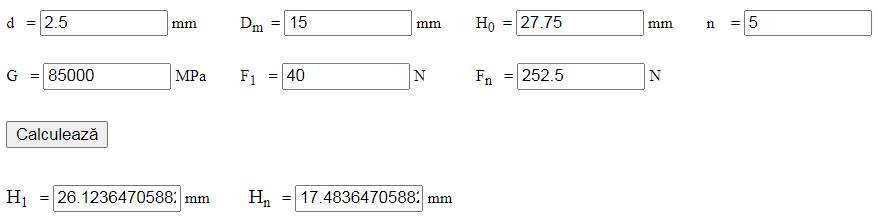
– spring stroke h = H1 − Hn = 26.1 − 17.5 = 8.6 mm;
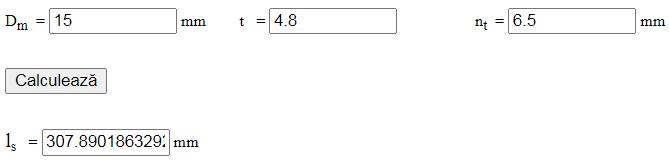
– blank length (developed wire length before coiling) ls = 308 mm.
Tightening torque of the threaded joint (applied with the wrench)
– parameters of the joint elements: thread M10, d = 10 mm, d2 = 9.026 mm, p = 1.5 mm; clearance hole diameter D1 = 11 mm;
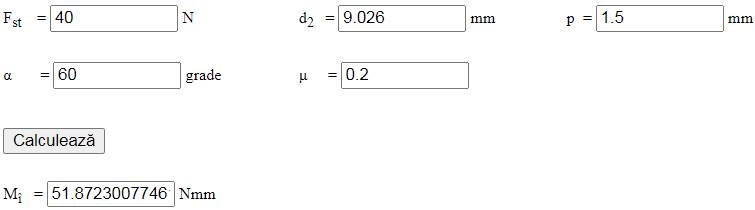
– thread torque (friction in the thread), with Fst = 40 N, µ = 0.25 (friction coefficient in the thread), α = 60° (profile angle of the metric thread) and p = 1.5 mm (thread pitch): Mî = 51.9 Nmm;
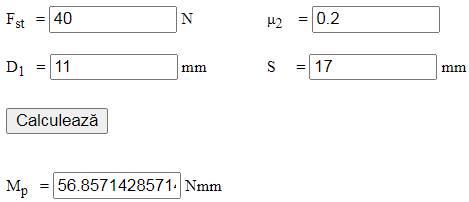
– friction torque between nut and washer, with Fst = 40 N, µ2 = 0.2 (friction coefficient between nut and washer) and D1 = 11 mm (clearance hole diameter): Mp = 56.9 Nmm;
– nut tightening torque (applied with the wrench):
Mc = Mî + Mp = 108.8 Nmm,
which tightens the threaded joint and therefore compresses the spring with the assembly force F1 = 40 N.
Constructive-technological shape
Constructive-technological drawing (including the spring characteristic)
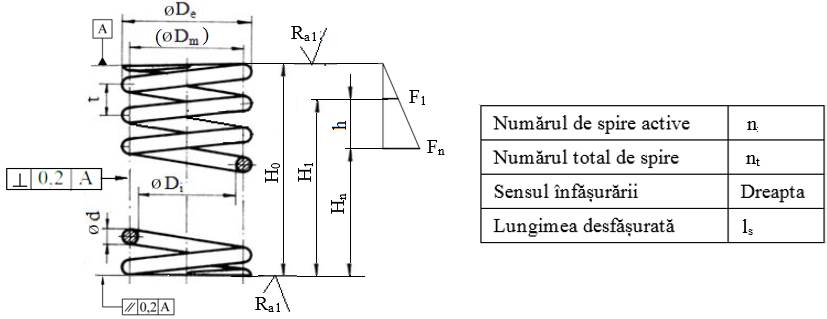
Adopted dimensions and constructive-technological parameters:
– geometric parameters: d = 2.5 mm, t = 4.8 mm, Di = 12.5 mm, Dm = 15 mm, De = 17.5 mm, n = 5, nt = 6.5, H0 = 27.8 mm;
– parameters of the elastic characteristic: H1 = 26.1 mm, Hn = 17.5 mm, h = 8.6 mm, F1 = 40 N, Fn = 252.5 N;
– the seating faces are ground after heat treatment to a roughness Ra1 = 3.2 μm; perpendicularity and parallelism tolerances must be ensured;
– when checking the elastic characteristic, force tolerances of ±10 N are considered.
Adopted dimensions of the threaded joint elements (bolt-nut):
– eye bolt with thread M10, d = 10 mm;
– hexagon nut: M10, S = 17 mm, m = 8 mm;
– plain washer: d = 10 mm, d1 = 10.5 mm, d2 = 20 mm, h = 2 mm;
– Grower spring washer: MN 10, d = 10 mm, d1 = 10.2 mm, d2 = 15.2 mm, g = 2.5 mm.